Scaling iPSC manufacturing without losing control of cell quality
Human induced pluripotent stem cells, or iPSCs, combine extensive self-renewal with the ability to differentiate into cell types representing all three embryonic germ layers. This makes them a powerful starting material for regenerative medicine, cell therapy, disease modelling, drug development and organoid production.
Their biological potential, however, comes with a demanding manufacturing challenge.
iPSCs are highly responsive to changes in their environment. Dissociation stress, aggregate size, oxygen availability, nutrient gradients, hydrodynamic forces and small differences in handling can influence cell survival, pluripotency and subsequent differentiation.
Conventional two-dimensional culture can support research-scale workflows, but producing large quantities in plates or flasks requires extensive scale-out, repeated manual handling and large amounts of incubator space, medium and matrix material. Every additional culture vessel also introduces another opportunity for process variation.
The Osilaris bioreactor provides an alternative: expanding iPSCs in a closed, single-use and controlled culture environment, with the flexibility to support either adherent microcarrier culture or self-aggregating suspension culture.
Internal data within Osilaris, shows how iPSCs can be expanded to an average of 4.1 × 10⁸ cells, with more than 95% of harvested cells expressing key pluripotency markers.
Why iPSCs are such a valuable manufacturing platform
Unlike adult stem cells, iPSCs can be generated by reprogramming somatic cells back to a pluripotent state. Under suitable culture conditions, they can subsequently be expanded for many passages and differentiated into a broad range of specialized cell types.
This creates opportunities across several fields:
- Patient-specific disease models for studying genetic and acquired disorders
- Drug screening and toxicity testing using human, disease-relevant cells
- Autologous therapies based on cells derived from an individual patient
- Allogeneic therapies manufactured from characterized donor-derived cell banks
- Production of cardiomyocytes, neurons, retinal cells, pancreatic cells and other specialized populations
- Generation of engineered immune cells, including iPSC-derived NK- and T-cell candidates
- Production of iPSC-derived organoids and other three-dimensional tissue models
For many therapeutic applications, the iPSCs themselves are not the final product. They are an expandable starting material that must then be differentiated, purified and characterized. The quality and consistency of the expansion stage can influence the performance of the entire downstream process.
The manufacturing bottleneck: more cells are not enough
An effective iPSC expansion process must produce the required cell number while preserving the biological attributes needed for differentiation and therapeutic development.
Important process and product attributes might include:
- Viable-cell yield and population-doubling time
- Aggregate or spheroid size and size distribution (in suspension culture)
- Expression of pluripotency markers
- Absence of spontaneous differentiation
- Capacity for directed and trilineage differentiation
- Cell identity and culture purity
- Genomic and epigenetic stability
- Sterility and absence of adventitious agents
- Consistent performance between passages, batches and cell lines
These requirements make simple scale-out an increasingly difficult strategy. Large numbers of plates or multilayer vessels require repeated medium changes, cell dissociation, transfer and reseeding. They also make it harder to maintain identical environmental conditions across the entire cell population.
Suspension bioreactors can scale by increasing working volume instead of multiplying culture vessels. Research has demonstrated that human iPSCs can be expanded to very large quantities in single-use suspension bioreactors, but also shows that aggregate formation, hydrodynamics and process monitoring must be carefully controlled. Abecasis et al., 2017
Aggregate-based suspension expansion
In the suspension configuration, dissociated iPSCs self-assemble into spheroids without requiring an attachment surface. This removes the need for microcarriers and can simplify raw-material and downstream-processing requirements.
Aggregate culture introduces a different challenge: spheroids must remain within an appropriate size range.
If aggregates become too large, cells at their centre may experience limitations in oxygen and nutrient transport, accumulation of metabolic waste or unwanted differentiation. Published bioreactor studies identify aggregate-size control as one of the central parameters in scalable iPSC manufacturing. Nogueira et al., 2019
Osilaris uses programmable rocking to keep aggregates suspended and influence their formation, growth and interaction. The motion profile can be adjusted as spheroids increase in size, rather than relying on a fixed agitation condition throughout the culture.
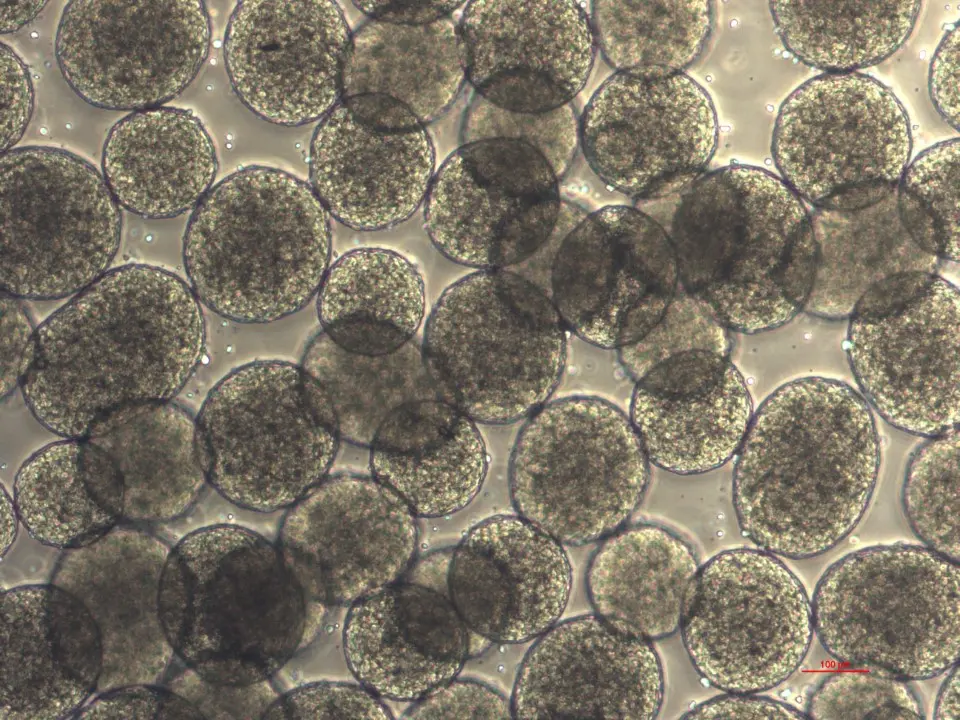
Light microscopy of iPSC spheroids in the Osilaris™
Demonstrated closed,
multi-passage iPSC expansion
Scinus and Stemmatters evaluated a cell-only, aggregate-based expansion process using WTC-11 human iPSCs in the Osilaris suspension bag.
The process began with single cells inoculated at 1 × 10⁵ cells/mL in 300 mL of StemScale medium supplemented with the ROCK inhibitor Y-27632. The cells formed spheroids of approximately 100–200 µm before growing towards a target range of approximately 300–400 µm.
A three-stage expansion was performed over 10–11 days, with closed in-bag dissociation and passaging on days 3 and 7.
Across three Osilaris runs, the study reported:
- An average harvest of 4.1 × 10⁸ cells, with a standard deviation of 1.3 × 10⁸
- Expansion of up to 18.33-fold
- Population-doubling times that remained below approximately 24 hours
- More than 95% expression of OCT3/4, SOX2, NANOG, SSEA-4 and TRA-1-60
- Less than 1% expression of CD13, used as an indicator of differentiation
- Recovery of typical compact iPSC colony morphology after replating
- Retention of differentiation capacity towards all three germ layers
The results represent a proof of concept with the WTC-11 cell line, but were also validated with different commercial providers of iPSCs. Additional donor and cell-line validation, and extended genomic characterization are currently being performed.
Scaling by volume inside the
same culture bag
The Osilaris suspension culture bag culture volume can be expanded progressively by adding medium as the cell population increases while controlling the mixing in an headspace free environment. This approach offers several advantages:
- Fewer vessel-to-vessel transfers during scale-up
- More consistent exposure to the same culture environment
- Efficient use of expensive iPSC medium during early process stages
- Easier integration of repeated expansion stages into one closed workflow
Controlling spheroid size with
programmable rocking
Aggregate size is not simply a visual characteristic. It affects mass transfer, cell-cell signalling, proliferation, spontaneous differentiation and the accessibility of dissociation enzymes.
In the Osilaris study, the spheroids were maintained below approximately 400 µm, with a target tolerance of about ±50 µm, by combining timed passaging with adjustments to the rocking program.
As aggregates grew, the vertical pause in the rocking cycle could be modified to help prevent settling and excessive clumping. This adds a mechanical process-control option without introducing a rotating impeller into the culture bag.
The result is a platform that can:
- Keep cell aggregates suspended
- Reduce uncontrolled aggregate merging
- Adapt agitation as the culture changes
Independent research similarly shows that reproducible aggregate formation and monitoring are essential for scalable iPSC suspension culture because large spheroids can develop oxygen and nutrient gradients. Schwedhelm et al., 2019
Integrated pH and oxygen
control without direct sparging
iPSC metabolism changes rapidly as cell density increases Huang et al. 2025, Manstein et al., 2021. Without adequate control, oxygen consumption, lactate production and nutrient depletion can cause the culture environment to drift.
Osilaris bags include optical pH and dissolved-oxygen sensors. Sensor measurements provide feedback to the patented Carboxygenator, which adjusts the delivery of oxygen, carbon dioxide and nitrogen through gas-permeable tubing in the recirculation loop.
Because gas transfer does not depend on direct sparging into the culture, the system can operate without bubbles, foam or a conventional gas–liquid headspace. This is particularly useful for sensitive cells and aggregates because it avoids an additional source of hydrodynamic stress.
The control concept supports:
- Continuous measurement of pH and dissolved oxygen
- Feedback-based gas adjustment
- Gas exchange without direct bubble contact
- A more homogeneous culture environment
- Process-data collection for development and scale-up
- Definition and monitoring of critical process parameters
What differentiates Osilaris for iPSC manufacturing?
A bioreactor does more than providing additional volume. Its value depends on how well it addresses the specific biological and operational requirements of the cells being produced.
Closed-loop serial passaging
The ability to wash, dissociate, dilute and restart the culture inside the single-use assembly is a meaningful differentiator. Many suspension-expansion workflows still require external harvesting and vessel-to-vessel transfer between passages.
Expansion over a broad
working-volume range
Increasing the culture volume within the same bag can reduce the number of process transitions and help conserve medium during early expansion.
Cell-only aggregate culture
The suspension workflow does not require microcarriers. This removes an additional raw material and avoids the need to separate the final cell population from a solid culture substrate.
Programmable, impeller-free mixing
The rocking motion can be adapted to cell density and spheroid development. The absence of a rotating impeller eliminates direct impeller contact and supports a lower-stress environment for sensitive pluripotent cells.
Headspace-free gas management
The Carboxygenator provides controlled gas transfer without direct sparging or a conventional air–liquid interface, avoiding bubbles as another potential source of shear and foam.
Integrated sensors and flexible connections
In-line pH and dissolved-oxygen sensing, together with tubing connections for sampling, medium addition and additional analytical technologies, supports data-driven process development.
Reduced dependence on manual scale-out
Replacing growing numbers of culture vessels with a controlled three-dimensional process can reduce incubator footprint and dependence on individual operator technique
One platform for changing development needs
The same platform can support early process development, adherent or suspension expansion, serial passaging and integration with upstream and downstream operations. This flexibility is valuable in a field where cell lines, media, differentiation protocols and regulatory expectations continue to evolve.
From iPSC expansion to
differentiated cells and organoids
Expansion is only one part of an iPSC manufacturing process. After sufficient starting material has been generated, cells may be directed towards specialized populations such as cardiomyocytes, neurons, retinal cells, pancreatic progenitors or immune cells.
iPSCs can also serve as the starting material for organoid workflows. Depending on the application, controlled iPSC expansion could be followed by aggregate conditioning, lineage induction and organoid formation.
The optimal expansion conditions are not necessarily the optimal differentiation conditions. Aggregate size, medium composition, oxygen setpoint and agitation may need to change as cells transition from pluripotency towards a specific lineage.
For that reason, Osilaris can be considered as a configurable process platform rather than a fixed recipe. Its sensors, adjustable motion, flexible flow paths and support for both adherent and suspension culture allow process conditions to be adapted to the intended product.
Supporting both personalized and allogeneic strategies
iPSC manufacturing can follow different therapeutic models.
In a patient-specific or autologous strategy, cells are generated from an individual patient, expanded and differentiated into the required therapeutic population. This can provide a close genetic match, but the process must manage small starting quantities, treatment timelines and relatively high manufacturing costs.
In an allogeneic strategy, a well-characterised donor-derived iPSC line can be expanded into a master cell bank and used to manufacture multiple batches. This can improve standardisation and availability, although immunological compatibility and any cell-engineering strategy must be evaluated for the intended product.
Osilaris can support both approaches:
- Its lower-volume starting range is relevant to patient-specific or early-stage cultures.
- Progressive in-bag volume expansion helps connect a small inoculum to larger production quantities.
- Closed processing can support parallel, decentralised or multi-site manufacturing concepts.
- Controlled and recorded culture parameters can assist technology transfer and comparability.
- The same platform can be configured for different cell lines and downstream products.
Quality must be designed into the expansion process
High expression of pluripotency markers is an important result, but it is not sufficient on its own to establish the suitability of an iPSC population for therapeutic manufacturing.
A product-specific control strategy may also need to address:
- Cell-line identity
- Karyotype and genomic integrity
- Copy-number and sequence variants
- Epigenetic characteristics where relevant
- Sterility, mycoplasma and adventitious-agent testing
- Residual reprogramming material
- Differentiation efficiency and consistency
- Residual undifferentiated cells after differentiation
- Tumorigenicity risk
- Potency and functional performance of the final differentiated product
Long-term culture can select for genetic and epigenetic changes that provide a growth or survival advantage. This is why reducing unnecessary handling and passages should be combined with scheduled genomic characterization, not treated as a substitute for it. Kim et al., 2024
The ISSCR Standards for Human Stem Cell Use in Research likewise emphasise cell identity, culture integrity, pluripotency, genomic characterisation and consistent reporting.
Developing the next generation of iPSC manufacturing
Scinus is extending its iPSC work through collaborative research programs focused on sensing, automation, media development and robust three-dimensional expansion.
Within the Dutch NXTGEN Hightech program, Scinus leads bioreactor-development activities that include iPSC cultivation and differentiation, animal-component-free media, nutrient sensing, sampling and microfluidic integration.
The RHYTHMS Eurostars project brings together Scinus, MyCellHub, Stemmatters and Skåne University Hospital. Its objectives include robust 3D iPSC expansion, real-time nutrient monitoring and software-supported operation for more decentralised, GMP-oriented manufacturing.
These collaborations support the development of a wider manufacturing ecosystem around Osilaris: not only the culture chamber, but also the media, measurements, software and control strategies needed to run reproducible iPSC processes..
Read more about the NXTGEN program
Develop your iPSC process with Scinus
Whether your program is moving from planar culture to three-dimensional expansion, comparing microcarrier and aggregate formats or preparing a process for translation, Scinus can help configure Osilaris around your cells and manufacturing objectives.
Find out more about our services
Discuss your iPSC application with an expert
Find our more about the Osilaris bioreactor