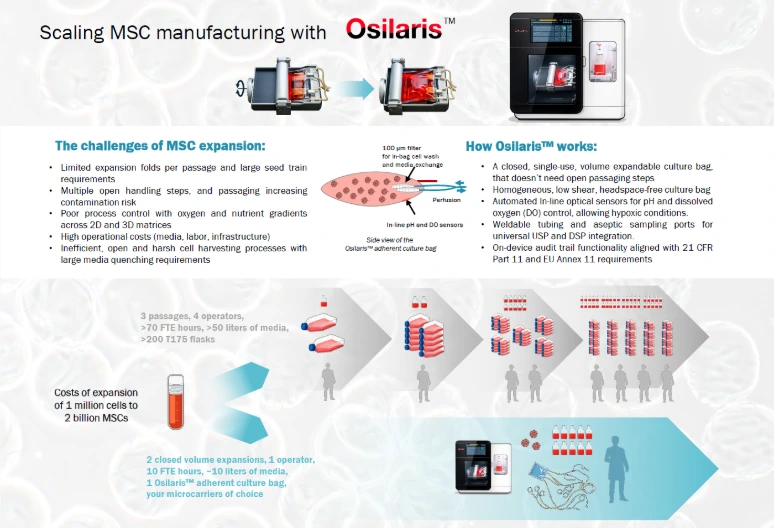

Which MSC tissue sources have been successfully cultured in the Osilaris bioreactor?
We have successfully expanded mesenchymal stromal cells (MSCs) isolated from bone marrow, adipose tissue, and Wharton’s jelly.
Although donor- and source-specific biology can significantly affect cell attachment, growth, metabolism, and harvest, our most robust and extensively validated process uses bone marrow–derived MSCs. We recommend conducting a source-specific feasibility study before committing to expected yields or run durations.
What microcarriers should be used for an MSC culture?
We have successfully cultured MSCs from multiple tissue sources using research-use-only (RUO) and GMP-grade microcarriers with diverse surface chemistries from several suppliers. Conventional collagen-coated polystyrene microcarriers support MSC expansion and closed-system harvesting. Dissolvable microcarriers can further simplify downstream processing; however, the best microcarrier brand and chemistries depend on the exact application and manufacturing requirements.
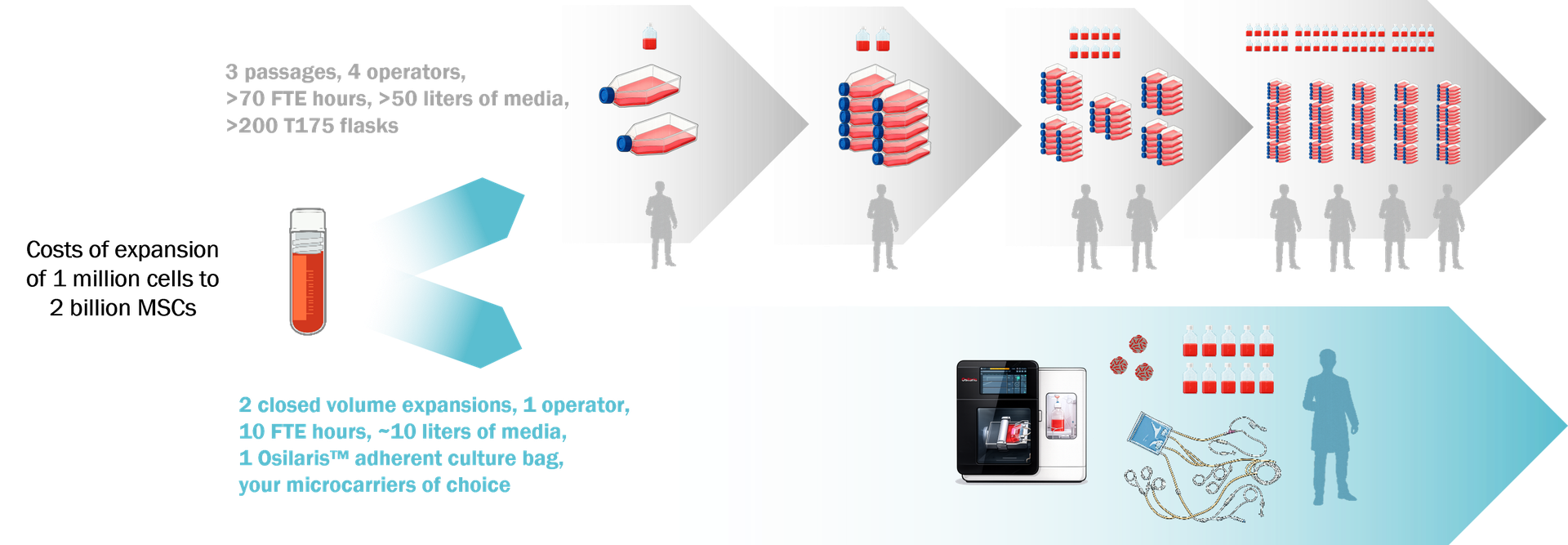
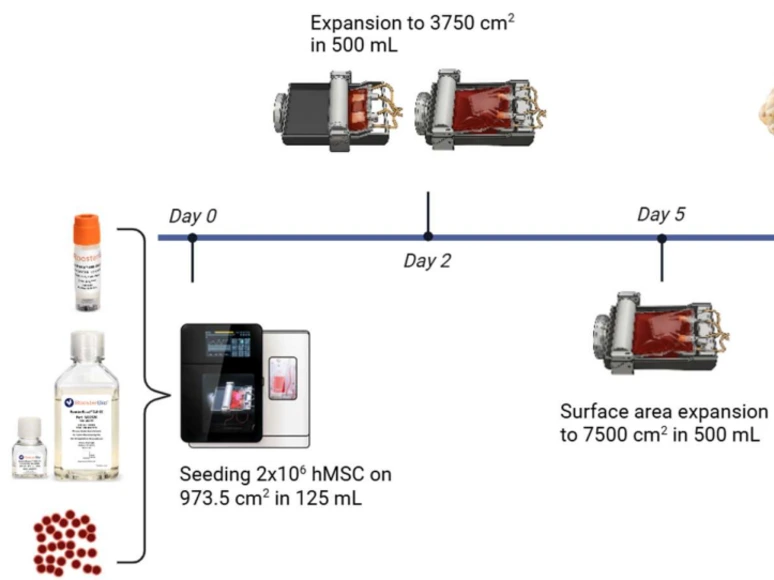
How do you transfer a flask-based process into the Osilaris?
A 2D protocol can
provide a useful starting point. Surface area–normalized seeding density,
attachment time, mixing, gas control, feeding strategy, and harvest conditions
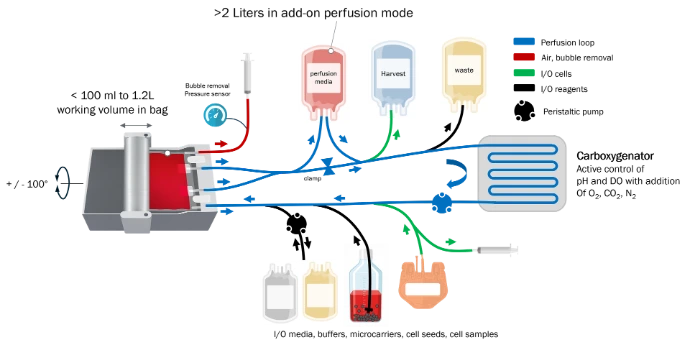
must be adapted to the bag format and selected microcarrier. We typically first perform a small-scale microcarrier
screening or spinner-flask study before conducting a confirmation run in the
Osilaris. We have successfully transferred multiple MSC- and MSC-EV–based
protocols from 2D culture to the Osilaris. Our Process Development team can help you choose the right
microcarrier and culture conditions.